Our History
Become part of history.
“Mystery, deep and shadowy broods over the desert. By night stars keep an ever tender watch from their sentinel stations in the sky: and by day white clouds, the great birds [...] filt across the azure field. ”
est. 1874
Historic Casa Cheruy is steeped in a series of historical narratives that define the transformation of the American Southwest and capture the essence of Tucson style. From the Hohokam who inhabited the Tucson basin and settled a large village on the property during the Sweetwater phase (circa C.E. 650-700); to the establishment of the US Territorial Fort Lowell that was active from 1873 - 1891; from the construction of a hispanic faming community in the ruins of he fort called El Fuerte, to the creation of an anglo artist colony on the outskirts of a growing desert city in the 1930’s. Casa Cheruy embodies the cultures and people who called this place home and today is opportunity to experience authentic Tucson.
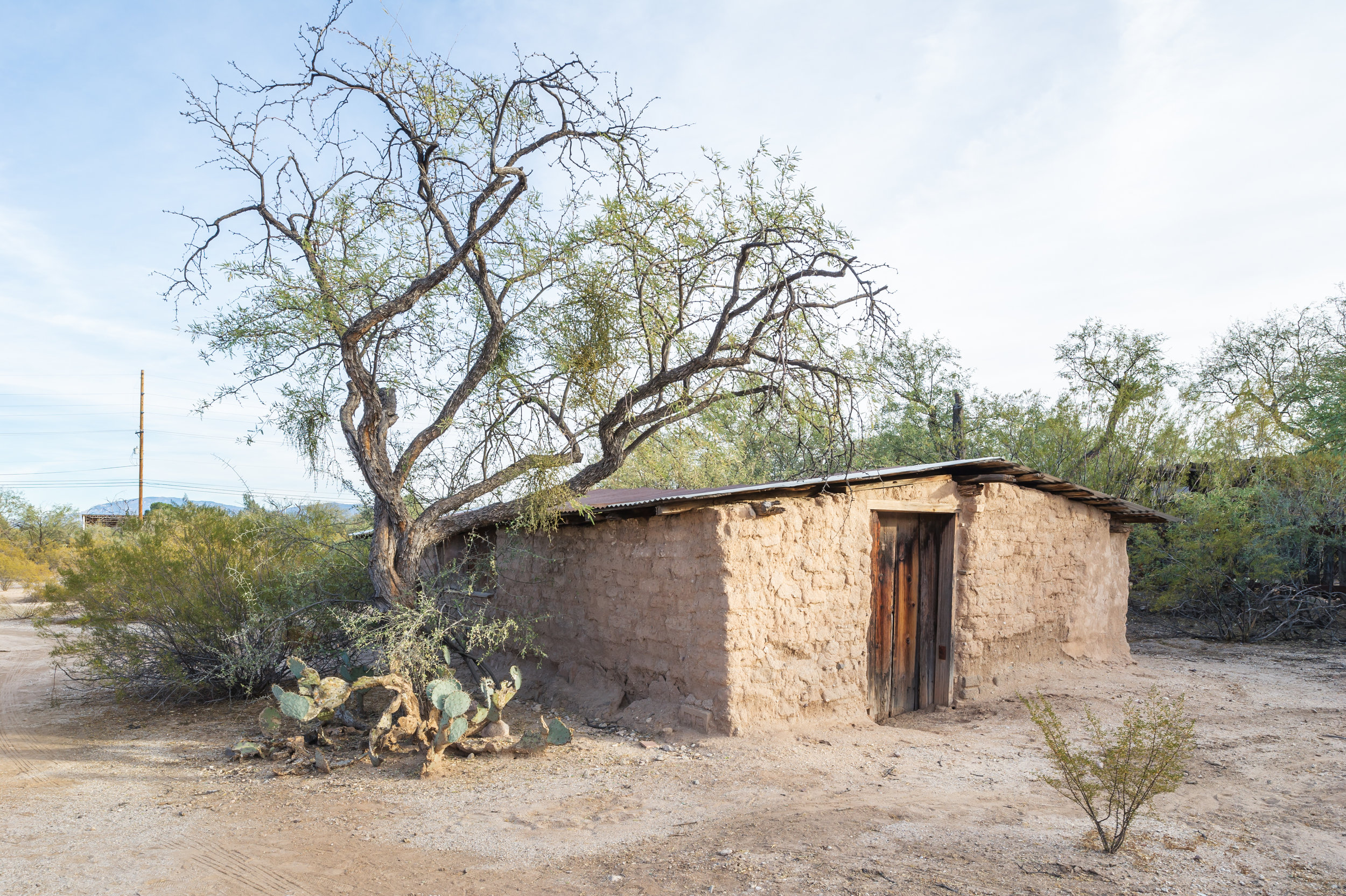
The mud adobe vernacular pueblo revival farm house was built on the site of the US Territorial Fort Lowell quartermasters corrals and stables, and incorporates wall fragments of the nineteenth century military installation built for the Apache Wars. The exact construction date of the house is unknown but dates to the 1910s - 20s. The diminutive adobe barn on the south edge of the property is located on the site of the Fort blacksmith shop and was likely used as a barn or hen coop in the first half of the twentieth century.
By 1937 the house was part of a 32 acre property owned by Mary Curtis and Ambus B. Earhart. By the 1940s, the property was owned by Margaret Hess, who sold it in 1948 to Germaine and Rene Churey. The Churey’s added the studio/guest house and used the home as an artistic retreat. The french couple hosted events and salons and the home became an important location for the Old Fort Lowell artist colony. The rambling house is built in a Pueblo Revival style with varying roof heights, hand plaster finished walls, and hammered tin and forged iron details throughout. The property is typical of the artist homes in the Fort Lowell Historic District and an outstanding example of authentic Tucson and Southwest design.

“Tucson is situated in beautiful mesquite riverbed country, overlooked by the snowy Catalina range. The city was one big construction job; the people transient, wild, ambitious, busy, gay; washlines, trailers; bustling downtown streets with banners; altogether very Californian. Fort Lowell Road, out where Hingham lived, wound along lovely riverbed trees in the flat desert.”
old fort lowell artist colony
Starting in 1934, Nan, Pete and european trained artist Charles Bolsius purchased and reconstructed the melting adobe ruins of the Fort Lowell Post Traders Store converting the property into their home and studio. Thought the 1930’s and 40’s a number other artists moved into Old Fort Lowell creating a important artist colony. Significant artists and intellectuals built homes and lived in the shadow of the crumbing adobe ruins including Win Ellis, modernist painters Jack Maul and Nik Krevitsky sculptor and designer Giorgio Belloli, Charles Bode, architectural designer Veronica Hughart, anthropologists Edward H. Spicer and Rosamond Spicer, Black Mountain College photographer Hazel Larson Archer and fiber artist Ruth Brown. The artist colony attracted writers and poets including beat generation author Alan Harrington and Jack Kerouac whose visit is documented in his iconic book On the Road.
René Cheruy and Germaine Cheruy were an important part of life in Old Fort Lowell. In their home they hosted salons, receptions and other artist and writers.
Madame Germaine Rouget Cheruy (1896 - 1980) was born in Paris, France. A talented female artist, she was the youngest person to be elected to the French Salon, the Société Nationale des Beaux-Arts. Cheury learned Japanese paintings and prints, designed costumes for the Paris Opera, and executed an extensive series of wash drawings of the Chartes Cathedral. Cheruy served as head of costume design for the Théâtre du Vieux-Colombier under famed early experimental director Jacques Copeau. She taught drawing and painting, and took weekly classes with various artists including Raoul Dufy who during this period worked as he head of fabric design for Bainchini. In 1924, Cheruy moved to America with her husband Rene Cheruy, who had taken an appointment as head of the French Department at Loomis School in Windsor, Connecticut. During this period her work was exhibited in galleries in New York, Boston, Yale University and at the Fogg Museum at Harvard University in Cambridge Massachusetts. In 1936 she showed watercolors and drawings at the Stavola Galleries in Hartford.
In 1939, “carrying two suitcases”, Cheruy arrived in Tucson, Arizona to spend the winter. She rented a small house and described Tucson as a “wilderness” where “everybody was friendly, you never shut your door. You could go to the movies for hours for 16 cents or the market with a dollar for the whole week’s shopping.”
Her husband René Cheruy (1880-1965) was a soldier, educator and artist who served as a secretary to French sculptor Auguste Rodin, was a professor of French language and literature, was decorated by the French and British governments, receiving the Croix de Guerre and the British Silver Military Medal for bravery in the field; he was also decorated with the Cross of the French Legion of Honor by French President Charles de Gaulle for his service to the French government during and after World War I.
By the late 1940s the couple purchased Casa Cheruy establishing a home and studio.
In the 1960s the property was acquired by Jim and Betty Bennett who hired noted architectural designer Veronica Hughart to restore the home and add a large living room and master bathroom. The addition, blending into the historic fabric of the original house, is today considered an important example of her architectural work.
Casa Cheruy Collection
The Casa Cheruy Collection reflects the layered cultural history of Old Fort Lowell and the property’s long role as a gathering place for artists, writers, and designers in twentieth century Tucson. Acquired in 1948 by French artists Germaine Cheruy and Rene Cheruy, the historic adobe was transformed into an artist retreat and salon that became an integral part of the Old Fort Lowell Artist Colony.
At the core of the collection are works by Germaine Cheruy, including watercolors, drawings, and prints depicting the Santa Catalina Mountains and the Tucson Basin, many created from direct observation on the property during the 1940s. Her work reflects a refined European training combined with a deep sensitivity to desert light, atmosphere, and landscape, establishing Casa Cheruy as both a site of artistic production and a lens through which Tucson’s environment was interpreted by a transnational modern artist.
The collection brings together a broad group of artists whose practices reflect the Old Fort Lowell Artist Colony, twentieth century Tucson, and related regional and cultural traditions. Artists represented include Veronica Hughart, represented by abstract oil paintings and also the architectural designer of a twentieth century addition to the house; Charles Bolsius, with oil paintings and hand-carved furniture created for Fort Lowell interiors; and Hurlstone Fairchild, represented by paintings of regional subjects. The collection further includes works by cowboy artists Pete Martinez and Jack Van Ryder, as well as works by Ruth Cohen from the Dale Nichols School of Art and sculptural painted works by Charles Bode and Salvador Corona.
Ceramics and decorative arts play a central role in the collection, including Pueblo pottery by Maria Martinez and ceramics associated with her circle, and design work by Mary Colter through her Mimbres-inspired china. Together, these works situate Casa Cheruy within a layered artistic landscape that connects Indigenous traditions, Mexican and Southwestern craft, and the modern art community of twentieth century Tucson.
Displayed throughout the house rather than isolated as gallery objects, the Casa Cheruy Collection is experienced as part of daily life, consistent with the way the property functioned during the height of the Fort Lowell artist colony. The artworks, furnishings, and objects present Casa Cheruy as a living record of Tucson’s artistic heritage, where place, history, and creative practice remain inseparably linked.
The property was listed in the National Register of Historic Places in 1978.